
Labuan Bajo Market
The Speedboat Market of Labuan Bajo: Fast Movers, Fast Sales
5 min read Komodo Boat For Sale desk
In this article
The overnight fleet gets the photography, but the speedboat market is where Labuan Bajo’s boat trade moves fastest. A well-presented fast day boat with sound engines can go from listing to completed sale inside two weeks — sometimes inside a weekend during the pre-season scramble. That velocity creates opportunity and risk in equal measure, and buyers who understand the rhythm do considerably better than those who treat it like a yacht purchase.
Why these boats trade so quickly
Three forces compress the timeline. First, demand is operationally urgent: an operator who loses a boat to engine failure in July needs a replacement this week, not next quarter. Second, the assets are comparatively simple — two or three outboards, a GRP hull, basic electronics — so diligence that takes six weeks on a phinisi takes two days here. Third, the buyer pool is local and informed. Most purchasers already run boats, know the yards, and can assess a hull by walking its deck.
The consequence is that hesitation costs opportunities. A buyer who wants to “think about it over the weekend” in June is frequently told on Monday that the boat is sold.
The main categories
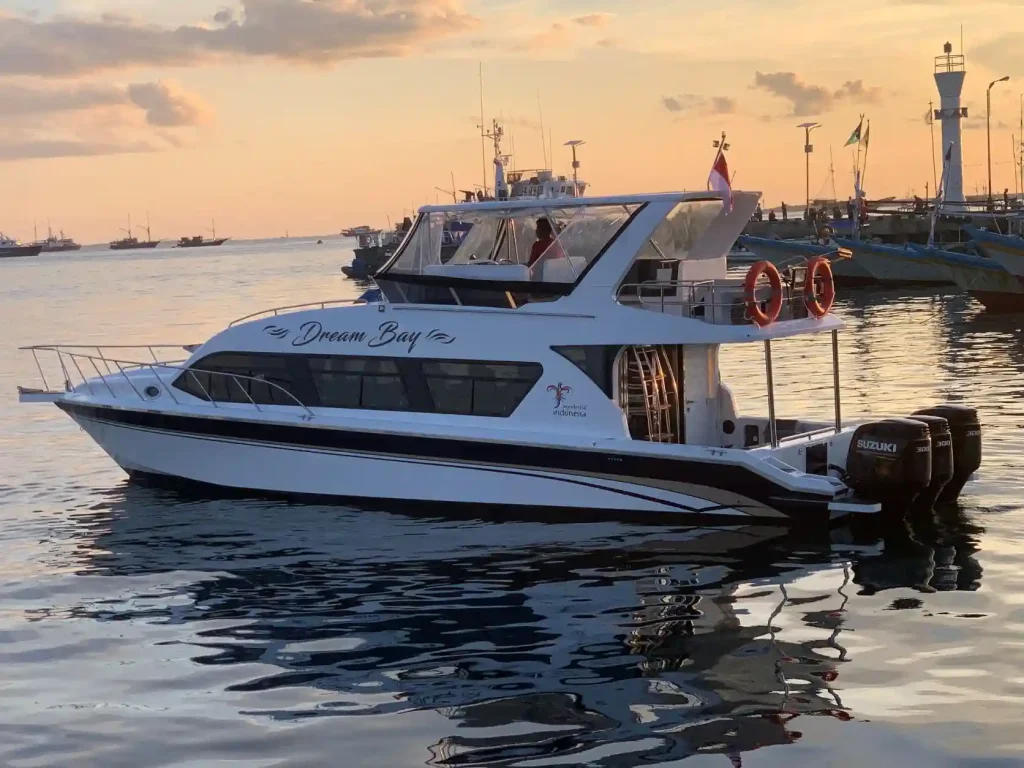
- Guest transfer boats — typically 10 to 14 metres, twin or triple outboards, canopy seating for twelve to twenty-five passengers. The workhorses that move guests to liveaboards, resorts and day-trip sites.
- Day-tour boats — similar size but fitted for a full-day itinerary: shade, a small head, cooler storage, a swim ladder that works in current.
- Fast cruisers — larger, sometimes with a cabin, positioned for private groups who want a Padar-and-Manta day without the overnight commitment.
- Dive day boats — with compressor and tank racking, a distinct sub-market with its own buyers.
Indicative USD bands
| Profile | Passengers | Indicative USD |
|---|---|---|
| Older transfer boat, twin outboards | 12–18 | 35,000 – 80,000 |
| Current-generation transfer boat | 18–25 | 80,000 – 160,000 |
| Day-tour boat, fitted | 15–25 | 90,000 – 200,000 |
| Fast cruiser with cabin | 8–16 | 180,000 – 400,000 |
Engine condition dominates these numbers more than anything else. Two boats with identical hulls can differ by 40,000 USD purely on outboard hours and service history.
Engines are the asset
On a speedboat, the outboards are not a component — they are most of the value. Assess them the way you would assess the main engines on a larger vessel:
- Hours and service records. Ask for the dealer service history. In this market it often exists, because the authorised service network keeps its own records even when owners do not.
- Compression test on every cylinder. Non-negotiable. It takes an hour and it is the single most informative test available.
- Salt intrusion and corrosion around the powerhead, mounting bolts and steering gear. Boats that live in this water and are rinsed inconsistently show it fast.
- Gearcase oil condition. Milky oil means water ingress and a bill.
- Propeller and skeg damage, which also tells you how the boat has been driven around shallow coral.
A boat with tired engines is not necessarily a bad purchase — repowering is a known quantity with a known cost — but it must be priced as a repower, not as a running boat.
Hull and structure checks
GRP hulls in constant tropical service develop predictable issues. Look at the transom around the engine mounts for stress cracking, check the stringers and bulkheads for delamination where the hull takes repeated slamming, and inspect any repair patches — many boats here have been repaired competently, but the quality varies enormously between yards. Sun damage to canopies, seating and wiring insulation is normal and inexpensive to fix; structural softness is neither.
Documentation moves faster too — which is the risk
Because these sales close quickly, the paperwork often gets compressed. Do not let it. The vessel still needs clean ownership documentation, and if it will carry paying passengers it needs the appropriate operating permissions. A speedboat that cannot legally carry guests is a very expensive private toy. Verify the documents before the deposit even when the seller is applying pressure — particularly when the seller is applying pressure.
How buyers position themselves to move fast
The operators who consistently secure the better boats do three things. They keep funds ready and pre-cleared, so a transfer does not wait on banking compliance. They maintain a standing relationship with a mechanic who can attend a compression test at a day’s notice. And they define their specification in advance — passenger count, engine brand, maximum hours — so that when a boat matches it, the decision is already effectively made and only verification remains.
The two-boat context
A large share of speedboat buyers here already own an overnight vessel. The fast boat handles guest transfers, crew changes, provisioning runs and emergency logistics, and it opens a day-trip revenue line that runs even when the phinisi is between charters. That combination is why demand for good speedboats stays firm regardless of what the liveaboard market is doing in any given season.
Related reading
- Inspecting Dive Compressors Before You Buy a Komodo Dive Boat
- Keeping the Crew: Retention Clauses in Komodo Boat Sales
- Labuan Bajo Boat for Sale — Boats Based in Komodo’s Charter Port
Frequently asked questions
How fast can a speedboat purchase realistically close?
Ten days is comfortable for a straightforward boat with clean papers: two days for inspection and compression testing, the rest for documentation and funds. Sales have closed in seventy-two hours, but that pace leaves no room for verification.
New engines, or a lower-priced hull with old ones?
Depends on the hull. A structurally sound hull with tired engines is a good buy at the right number, because repowering is predictable work. A tired hull with new engines is usually a trap — you have paid for the easy part.
Do speedboats hold value in this market?
Hulls depreciate slowly if maintained; engines depreciate on hours. Owners who repower on schedule and keep records generally recover a strong share of their investment, because documented boats sell first.
What passenger capacity is most useful commercially?
Eighteen to twenty-five covers the widest range of transfer and day-trip work. Below twelve the economics get thin; above twenty-five the boat becomes specialised and harder to fill outside peak weeks.
Komodo Boat For Sale is a specialist maritime brand and digital platform under Juara Holding Group. Vessel-sale, construction and refit contracts are issued by PT Komodo Galangan Nusantara; brokerage and charter representation by PT Komodo Bahari Nusantara; boat management by PT Komodo Vessel Management.
Talk to the desk
If you are weighing a specific vessel, send us the listing and the month you want to be operating. WhatsApp +62 811 3941 4563 or email [email protected]. Figures are quoted in USD.